
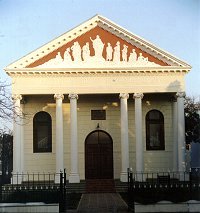
 Hofmeyr Hall Photo by Willem Malherbe | Prof J. M. Claassen 42 Rowan Street Stellenbosch, 7600 883 2956 |
 Grand-ducks, Donald and Daisy |
 Jo-Marie's grand-doggie, Mini (click for "Author's dogs) |
Extract from the closing chapter of her book
Johanna Maria Latsky was born on 9 June 1940 in Cape Town. She studied at
Stellenbosch University (BA in Latin and English, cum laude, 1960; MA in
Latin, cum laude, 1970; Third major in Greek, 1972, PhD, 1986)
MA thesis: Humor by Tertullianus (in Afrikaans)
Doctoral thesis: Poeta, exsul, vates: a stylistic and literary analysis of
Ovid's Tristia and Epistulae ex Ponto.
Jo-Marie also attained a teaching diploma at the University of Cape Town
(Senior Education Certificate,cum laude, 1961).
She was a visiting fellow at different times at the universities of Princeton,
Cambridge, and Texas at Austin.
She taught at Stellenbosch University Latin Department (later Classics
and then Ancient Studies) for about 34 years; first as temporary part-time
lecturer, and following 1979, full time as junior lecturer,becoming
associate professor in 1994. She retired in March 2001.
She has served on the National Executive of the Classical Association of South
Africa and is presently Chair of the Western Cape branch. She organised a
Latin Olympiad for schools on four occasions (1989 - 96), and is SA
Certification Board Moderator for Latin.
She is internationally known for her work on the poet Ovid and the prose author
Cicero, and for research on Latin teaching and the use of computers in
education.She has presented many papers both locally and abroad; her
particular interest being the academic development of students.
Jo-Marie is
married to Pieter Eduard Claassen and has a daughter and
a son. She lives in Mostersdrift, Stellenbosch. She is a niece of Lulu Latsky.
Hobbies: People, family life, academic pursuits, singing, nature
Favourite books:biographies, historical novels, nineteenth century literature
Quote:"People are more important than things"
"A large part of the world's work is done by people who are not feeling very well"
 Displaced Persons: the literature of exile: from Cicero to Boethius
Translation:
NP van Wyk Louw, Germanicus, translated into English verse (e-book) (flyer of the English translation of Van Wyk Louw's Germanicus
Co-author :
1 Latin text with commentary
Tria Saecula , series of Latin texts with commentaries
1 Latin/English/Afrikaans .vocabulary list
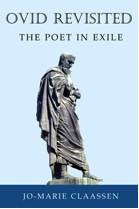
Ovid revisited: The Poet in Exile, Duckworth, 2008 (See blurb of the book pdf)
Author of some 80 academic and popular articles
"I close with an interesting double example that may be traced back to Ovid as establisher both of the conventions of exilic literature and of protest against public interference into private morality. When the Afrikaans poet N. P. Van Wyk Louw was teaching in Amsterdam in the fifties of this century, he produced a volume of 'sad songs', entitled Tristia. Longing for South Africa, his patria and his spiritual Rome, is a central theme, but so too is criticism of the country. South Africa was then in the first years of the formal establishment of racism as a political principle ('apartheid') and as a means of ordering the state, a system that later turned the eyes of the world upon the country as the place where the state interfered with the basic fabric of human existence. As with his predecessors, Louw's work reflects the political issues of his era, but also his own cultural preferences. He would like to remake Africa in a European, Mediterranean image:
My land, my dor, verlate land:Strongly influenced by Louw, in the seventies came Breyten Breytenbach, the enfant terrible of the Afrikaans literary scene. No Latinist, he had a stronger and more direct affinity with Ovid; he transgressed the grotesque, race-besotted South African marriage laws by wedding a 'brown' Vietnamese.{90} The ideology of apartheid had become firmly established as the ruling principle of South African society, and central to it was a rigid set of embargoes on interracial marriage, far more stringent than Augustus' attempts to regulate Roman domestic morality by means of legislation. These embargoes turned that most private and moral of human customs, marriage (if contracted between 'unsuitable' partners), into the most immoral of South African public 'crimes'. Breytenbach spent many years, with his wife, in self-imposed exile in Paris, writing in his beloved and hated Afrikaans, but publishing in his home country. He, too, wanted to remake his lost home into a spiritual haven, an ideal state, an alma Roma where amor is replaced by a universal caritas:
iets wens olywe groei in jou:
dat alles klein, Latyns, gaan word
en kalk-wit kerkies bou.
'H. Petrus', TristiaMy land, my drab, deserted land:
oh, that olives grew in you,
that all could shrink to Latin size
and sprout small chalk-white churches too.
'St. Peter', Tristia, translated by JM Claassen
My broer, my dor, verlate broer:This poem consciously imitates Louw, but Ovid looms large in it as an unconscious intertext. Ovid would have understood its political thrust and the love of his mother-tongue which the poet exhibits while rejecting its authoritarian abuse in the kind of oppressive and censorious legislation that strove to direct private lives by public decree. And when Breytenbach, inept political intriguer that he was, secretly slipped back into the country and was caught red-handed in a vain political plot, his love-hate writings from prison, also in English, reflect the psychological resilience that we have seen enhanced in our Roman exiles by the solace offered by their literary exertions.
iets wens dat mens weer in jou groei
dat alles groots, Afrikaans gaan word
en jy ook in mensbruin mense bloei.
'Bruin reisbrief' ,OorblyfselsMy brother, my drab, deserted brother,
oh that your human heart would come alive
that greatness Afrikaans could be
and you too as brown humanity could thrive
'Brown travelogue', Remains, translated by JM Claassen.
Breytenbach in prison exhibits an inner exile, an alienation from the religion that was subverted for political ends, a questioning of the values of the wielders of political and judicial power, a concern for literary and cultural issues voiced in ingenious, punning play, and an ostensible self-denigration, that point for point agree with the intellectual resistance voiced by Ovid in his own love-hate relationship with Roma aeterna
 www.StellenboschWriters.com © Rosemarie Breuer
 Books
Books